What is an AI receptionist and how does it answer calls and messages?
Guide For any business Updated 10 min read By the Solwees team
An AI receptionist is software that answers a business’s phone calls and messages in ordinary language. An AI receptionist answers common questions, books appointments into the booking system or calendar the business uses, and passes the conversation to a person when it cannot help. Unlike a phone menu or voicemail, it finishes the request during the conversation, at any hour.
Key takeaways
- An AI receptionist understands natural speech and text; an IVR menu only routes by key presses, and voicemail only records.
- The deciding question is whether it writes the booking into the system the business already uses. Without that it only takes messages.
- Vendors price by minutes, calls, unique customers or locations. Paid plans start at $29 a month as of October 2026, and some vendors have a free tier.[1, 2]
- Complaints, refunds, medical and legal questions should always be passed to a person.
What an AI receptionist is
An AI receptionist is a program that takes the first contact with a customer in place of a front desk employee: it picks up the phone or replies in a messenger, understands a request said in ordinary words, and acts on it. The same category is sold under other names: AI phone agent, AI answering service, AI booking assistant, virtual receptionist.
Three parts make an AI receptionist work. A knowledge base holds what the business would tell a customer: services, prices, opening hours, rules. A connection to the booking system, calendar or CRM lets it see free time and write the booking. Rules set by the owner say which topics always go to a person.
How an AI receptionist handles a phone call, step by step
An AI receptionist handles a phone call in seven steps: the call is forwarded to it, it greets the caller, understands the request, checks the knowledge base and the schedule, books or answers, hands over when needed, and keeps a record. The caller speaks in full sentences and presses no keys.
- The call arrives. The business keeps its number and forwards calls to the assistant: all of them, only unanswered ones, or only after hours. Goodcall and Booksy describe this setup.[3]
- The greeting. The assistant answers at once with the business name. Some products always say they are an AI: Fresha states that this is built into its AI Concierge and cannot be turned off.
- The request. Speech is turned into text, and the assistant works out what the caller wants: a booking, a change, a price, directions.
- The lookup. The assistant reads services, prices and free slots from the knowledge base and the connected booking system.
- The action. The assistant books, moves or cancels the appointment in that system and repeats the details to the caller.
- The handover. If the caller asks for a person, or the topic is outside its rules, the assistant transfers the call or takes a message with a summary.
- The record. The call is kept as a transcript, so the team sees what was agreed.
How an AI receptionist handles a chat, step by step
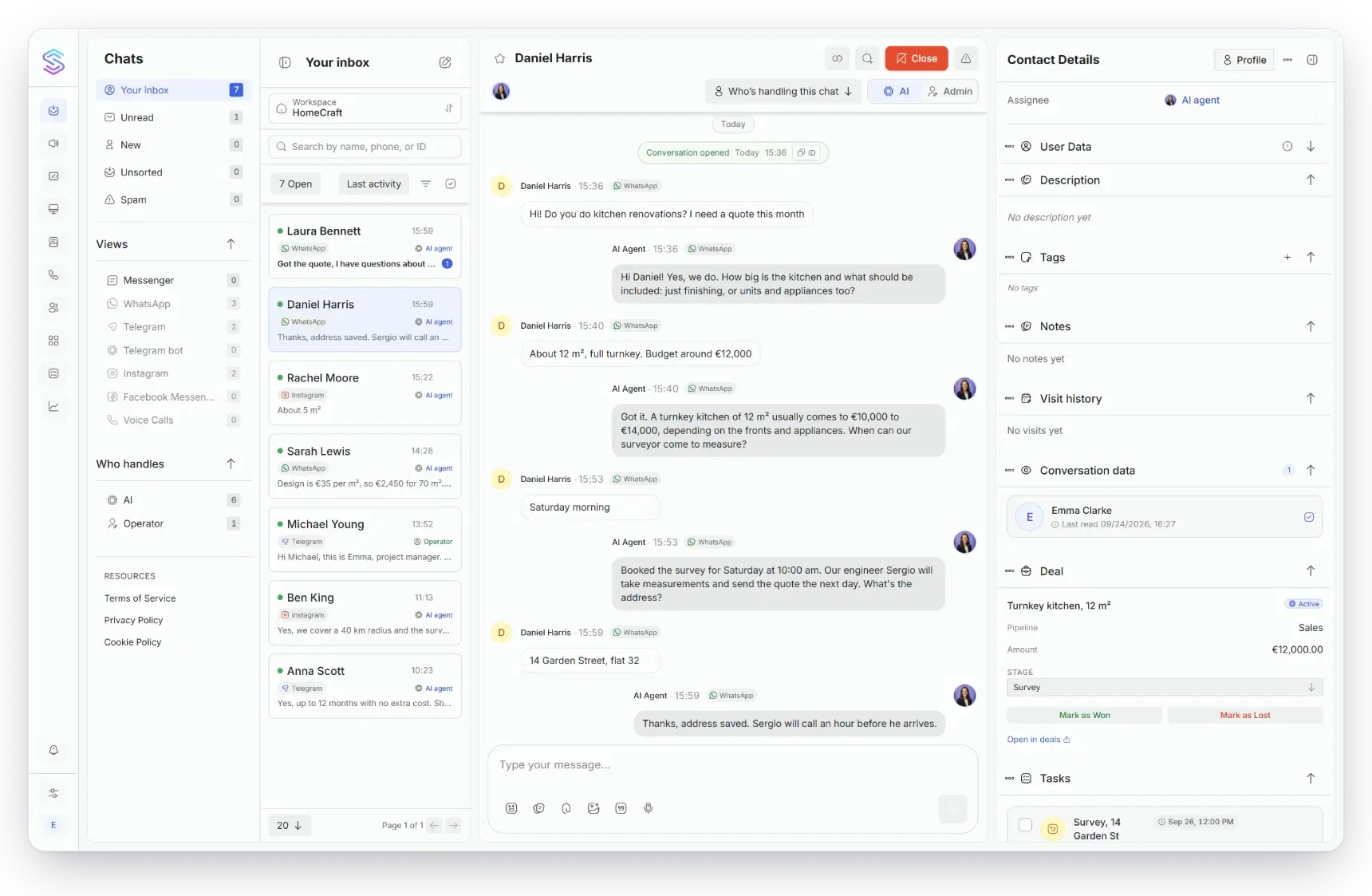
An AI receptionist handles a chat the same way as a call, without the voice: a message arrives in WhatsApp, Instagram, Telegram or the website chat, and the assistant replies in the customer’s language, offers free times, writes the booking and calls in a staff member when needed. A chat can pause for hours and continue.
- The message arrives in one of the connected channels and lands in a shared inbox.
- The reply. The assistant answers from the knowledge base: prices, what is included, how to get there.
- The booking. The assistant offers free slots from the booking system and writes the chosen one there.
- The handover. When the answer is missing or the customer asks for a person, a staff member gets a notification with a short summary and takes over the chat.
- The follow-up. A confirmation and a reminder go out in the same messenger, where the product supports them.
Solwees, for example, answers WhatsApp, Instagram, Telegram, Messenger, website chat and email in one inbox, and the same assistant answers phone calls. One limit today: in the website chat widget a reply typed by a staff member does not reach the visitor yet.
How an AI receptionist differs from an IVR menu, voicemail, an answering service and a chatbot
An AI receptionist differs from the older tools in one thing: it completes the request itself, in ordinary language. An IVR menu routes the caller by key presses. Voicemail records a message for a callback. A human answering service does the work with people and bills for their time. A scripted chatbot follows fixed buttons in one channel.
| Tool | How the customer communicates | What happens during the contact | Limits |
|---|---|---|---|
| AI receptionist | Natural speech or text, on the phone and in chats | Answers, books, changes or cancels, hands over to a person | Knows only what is in the knowledge base and the connected systems |
| IVR menu | Fixed menus and button presses[4] | The call is routed to a department or a queue | Books nothing; the caller still waits for a person |
| Voicemail | A recorded message | Nothing until someone calls back | The request waits for working hours |
| Human answering service | A conversation with a live receptionist | Answers questions, schedules appointments, connects callers | Billed by receptionist minutes or calls: from $250 a month at Ruby[5] |
| Scripted chatbot | Buttons and keywords in one chat channel | Answers the listed questions, collects a request | No phone calls; stops at a question outside the script |
What an AI receptionist can and cannot do
An AI receptionist can hold several conversations at once at any hour, speak several languages, answer from the business’s own knowledge base and write bookings into a connected system. An AI receptionist cannot know what nobody told it, and it should not decide matters that need a person’s judgement, such as complaints, refunds or medical advice.
What it does well
- Answers while the staff are busy with a customer, after hours and on several lines at once.
- Books, reschedules and cancels in the connected booking system, so nobody enters the booking a second time by hand.
- Replies in the customer’s language. Booksy AI Receptionist lists English and Spanish, RingCentral six languages, Solwees 50+.[4]
- Keeps a transcript of every conversation.
- Passes the conversation to a person with a summary: see how handover works in Solwees.
Where it stops
- It answers only from the knowledge base. A price or a rule that is missing there should lead to a handover, not to a guess.
- Without an integration with the booking system it can only take a message. Check that the vendor names your system on its integrations page.
- Products have their own gaps. Booksy AI Receptionist does not yet book appointments with No-Show Protection. Vagaro’s Vera Receptionist cannot book by SMS and sends a link instead. In Solwees, Bitrix24 receives chats but not calls.
- Complaints, refunds, payment disputes and anything medical or legal should always be passed to a person.
What an AI receptionist costs
An AI receptionist for a small business costs from $29 a month on paid plans to a few hundred dollars or euros, as of October 2026, and some vendors have a free tier.[1, 2] The bill depends on what the vendor counts: minutes, calls, unique customers or locations. A human answering service starts several times higher.[5]
| Pricing model | What is counted | Published example |
|---|---|---|
| Per minute | Minutes in the plan; extra minutes are billed on top | RingCentral AI Receptionist: from $49 a month with 100 minutes, then $0.50 a minute.[6] Dialzara: $29 a month with 60 minutes.[1] |
| Per call | Answered calls, whatever their length | Smith.ai: 25 calls a month free; Pro $150 a month for 75 calls.[2] |
| Per unique customer | People who called in the month; minutes are not limited | Goodcall: $79 a month for 100 unique customers, then $0.50 each.[3] |
| Per location, with included usage | A price for a branch that covers a set volume of minutes, messages or staff | Fresha AI Concierge: €94.95 per location a month with 200 minutes and 500 messages, then €0.57 a minute and €0.04 a message.[7] BookingBee: from $99 per outlet a month, by number of staff.[8] |
| Per location and active clients | A plan per branch with a monthly limit of people the assistant answered; call minutes separately | Solwees: Solo €99 a month, Studio €249 with 100 call minutes. |
| Human answering service | Receptionist minutes or calls | Ruby: $250 a month for 50 minutes.[5] Smith.ai Virtual Receptionists: $300 a month for 30 calls.[9] |
A phone call uses telephony and speech processing for every second, so most voice products meter minutes. Goodcall argues that minutes say little about the value of a call and bills per unique customer.[3] Smith.ai bills per call and says per-minute billing rewards longer calls.[2]
Solwees prices as of October 2026, per location a month: Hub €39 (a shared inbox, no assistant), Solo €99 (the assistant in chats, 400 active clients), Studio €249 (adds answering phone calls, 100 call minutes, outbound calls and calling campaigns, 1,000 active clients), Network €499 (adds a network of branches with one shared channel, a quality check of answers, 300 minutes, 2,500 active clients), Enterprise from €999. On Solo a pack of 100 call minutes costs €39 once and does not expire. The trial lasts 7 days and needs no card. Details are on the pricing page.
How to choose an AI receptionist
Choose an AI receptionist by checking six things on the vendor’s own site before a trial: the channels it answers, the booking systems it names, how it hands over to a person, the languages, what the price counts, and who does the setup.
- Channels. List where customers reach you today. If half of them message you on WhatsApp or Instagram, a phone-only product covers half the work.
- Your booking system by name. “Works with any calendar” is not an integration. Look for your system on the vendor’s list.
- Handover. Find out what the customer hears when the assistant cannot help: a transfer, a message or a callback.
- Languages. Compare the list with the languages your customers speak.
- The unit of price. Estimate a busy month in that unit and check what happens above the limit.
- Setup and trial. Prefer a product you can set up yourself and try on real conversations before paying.
Product-by-product comparisons with sources: the best AI receptionist for small business and the best AI receptionist for hair salons.
Questions and answers
Is an AI receptionist the same as a virtual receptionist?
Not always. “Virtual receptionist” is used for two different things. Ruby uses the term for live, human receptionists who answer remotely, and states that an AI that conducts the call on its own is not how Ruby works. Other vendors use the term for software, so ask which of the two is sold.
Will callers know they are talking to an AI receptionist?
That depends on the product. Fresha states that its AI Concierge always discloses that it is an AI assistant and that this cannot be turned off. Goodcall tells businesses that it is important to disclose the AI to callers. A greeting that names the assistant as automated is the safer default.
What happens when an AI receptionist cannot answer?
A well-configured AI receptionist does not guess: it passes the call or the chat to a staff member, or takes a message with a summary. Fresha AI Concierge transfers the call or takes a detailed message. Booksy AI Receptionist sends the provider a callback request. With Solwees a caller reaches a person only in working hours, if a team member accepts the call in the mobile app within 30 seconds; otherwise the caller is told a manager will call back.
Does an AI receptionist replace a human receptionist?
An AI receptionist takes over the repetitive part of the front desk: bookings, changes, prices, opening hours, calls after hours. People stay for complaints, exceptions and everything that needs judgement. A business that wants every call answered by a person chooses a human answering service at a higher price: Ruby starts at $250 a month for 50 minutes.[5]
How long does it take to set up an AI receptionist?
Vendors of self-serve products state minutes, not days. Dialzara says most businesses are live in about 15 minutes, and RingCentral says most businesses get its AI Receptionist running in minutes without technical expertise.[4, 10] Solwees is set up by the owner in the dashboard during a 7-day free trial.
Can an AI receptionist answer WhatsApp and Instagram, not only calls?
Some can. Solwees answers phone calls, WhatsApp, Instagram, Telegram, Messenger, website chat and email with one assistant. BookingBee, a voice product for salons, says a business that relies on Instagram, website chat or WhatsApp needs a separate tool for those channels.
Sources (10)
All sources were accessed on .
- Dialzara. AI Receptionist Pricing.
- Smith.ai. Plans and pricing for AI Receptionist.
- Goodcall. Goodcall pricing.
- RingCentral. AI Receptionist: 24/7 Intelligent Virtual Answering Service.
- Ruby. Plans and pricing.
- RingCentral. RingCentral AI Receptionist plans and pricing.
- Fresha. Fresha pricing.
- BookingBee. AI Receptionist Pricing for Salons.
- Smith.ai. Plans and pricing for Virtual Receptionists.
- Dialzara. Dialzara home page.
Read next
See how Solwees answers your clients
The free trial covers the whole platform: up to 100 active clients and 20 call minutes.